Home >> News >> Company News
An Article to Help You Understand the Common Classifications of Oil Drilling Rigs |
作者:本站 发布时间:2025-03-10 浏览:75次 |
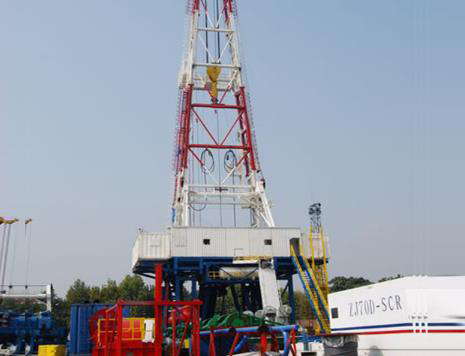
Oil drilling rigs can be classified into the following types based on their functions: 1. Exploratory Wells: These wells are drilled within oil and gas fields to determine the existence of oil and gas reservoirs, delineate the boundaries of the reservoirs, conduct industrial evaluation, and obtain geological data needed for oil and gas development. Wells drilled at various stages of exploration can be further divided into pre-exploratory wells, preliminary exploratory wells, and detailed exploratory wells. 2. Production Wells: These are wells drilled to extract oil and natural gas. Production wells can be further categorized into oil production wells and gas production wells. 3. Water (Gas) Wells: In order to improve recovery rates and development speed, water or gas injection wells are drilled in oil fields to supplement and rationally utilize the formation energy. These are often referred to as injection wells, sometimes specifically as water or gas injection wells. 4. Reference Wells: During the regional survey phase, these wells are drilled to understand the sedimentary characteristics of the strata and the oil and gas content, verify geophysical exploration results, and provide geophysical parameters. 5. Profile Wells: Drilled along large regional profiles in the covered area, profile wells are used to reveal the regional geological profile, study strata lithology, changes in facies, and look for structures. These wells are mainly used in the regional survey phase. 6. Parameter Wells: In oil-bearing basins, parameter wells are drilled to provide rock physics parameters for better understanding the regional structure. Parameter wells are mainly used during the comprehensive detailed survey phase. 7. Structural Wells: These wells are drilled to compile standard subsurface structural maps, understand geological structural features, and verify geophysical exploration results. 8. Data Wells: These wells are drilled to obtain data for compiling oil field development plans or for specific research during the development process. 9. Adjustment Wells: Drilled during the middle and late stages of oil field development, adjustment wells are used to adjust the original development well network and further improve development efficiency and ultimate recovery rate. These can include production wells, injection wells, and observation wells. 10. Monitoring Wells: When an oil field reaches a certain water cut stage, monitoring wells are drilled to understand the pressure in each oil layer, the distribution of oil, gas, and water, the distribution and variation of residual oil saturation, and the effects of various adjustments. These wells are used to explore the potential of the field. 11. Observation Wells: These wells are specifically drilled to observe the underground dynamics of an oil field during its development process. They monitor things like pressure in each oil layer, changes in water cut, and the water injection pattern of individual layers. Observation wells are typically not responsible for production tasks. Apart from their use in the oil industry, drilling is also widely applied in national economic construction projects such as exploration, hydrogeology, railways, and water conservancy. Drilling construction is frequently used in these areas as well. Drilling rigs can also be classified based on well depth structure into two-well, three-well, and four-well systems. Well Trajectory Classification: Straight wells, directional wells, extended reach wells, horizontal wells, and lateral wells. Completion Methods: Cased-hole perforation completion, slotted liner completion, open-hole completion, and tailpipe perforation completion. How to Understand Scientific Drilling Wells like the Songke No. 1 Well or the Soviet Union’s Kola Superdeep Borehole? If there is a distinction, scientific wells are primarily for research purposes. Since the goal is to extract all rock cores, very deep wells are not usually drilled unless needed. For example, a segment of granite core from marine drilling is displayed on the sixth floor of the Institute of Geology, Chinese Academy of Geological Sciences. Detailed logging and geophysical methods are applied to collect valuable exploration data that can be used for various research purposes. It’s rare to find completely core-sampled oil wells. Many production wells are only used for logging and other logging purposes, with some being heavily exploited. Once drilled, production wells are typically subjected to perforation fracturing, and then oil extraction begins. Research wells, however, do not involve perforation fracturing or any production-related activities. That concludes the discussion on the common classifications and distinctions of oil drilling rigs. For more related information, please stay tuned to JinTu Technology.
|